I. Summary of Weekly Meeting
。Have a discussion based on the Preliminary matching results by using SIFT descriptors
。Prospective future work:
- Creating a mechanism to enable to change the perspective of the Kinect frame
- Using this mechanism to find relevant parameters of locating the best position of the Kinect frame ->
So that we could get better matching result for future process of integrating hand-held frame into Kinect
II. Useful Tools
Cylinder:
http://www.matrixlab-examples.com/solid-of-revolution.html
http://www.ask-coder.com/4446757/how-to-plot-a-surface-with-a-texture-map
Deformation:
http://stackoverflow.com/questions/16239667/texture-map-for-a-2d-grid
Wednesday, 9 April 2014

Tuesday, 8 April 2014
Work of Camera Calibration (7) : Running the re-setup experiment
I. Save figure function in MATLAB:
http://www.mathworks.co.uk/help/matlab/ref/print.html
http://stackoverflow.com/questions/12160184/how-to-save-a-figure-in-matlab-in-from-the-command-line

II. Experimental setup:
。Target

。First scenario - near


。Second scenario - medium


。Third scenario - Far


III. We collect these datas:
* 'k-Img' means a Kinect frame; 'hh-Img' represents a Hand-held camera image
。3 k-Imgs under near, medium, and far distance to the target ... (for matching tasks)
。3 sets of k-Imgs under near, medium, far, which are taking under different perspective
around 360 degree ... (for stitching tasks)
。5 hh-Imgs with different scales
。5 sets of hh-Imgs under 5 different scales, which are taking under different perspective
around 360 degree
。10 hh-Imgs with simple affine transformation
。16 hh-Imgs under 2 different scales, which are taking under different perspective
around 360 degree
IV. Running the re-setup experiment: (matching tasks - for checking SIFT descriptors capability in
our cases)
* 'k-Img' means a Kinect frame; 'hh-Img' represents a Hand-held camera image
。1 k-Img (totals are 3 under different scales) V.S. 5 hh-Imgs (under 5 different scales)
。1 k-Img (totals are 3 under different scales) V.S. 10 hh-Imgs (with simple affine)
。1 k-Img (totals are 3 under different scales) V.S. 16 hh-Imgs under different
perspective (per dataset; totals are 2 sets of hh_Imgs under 2 different scales)
。1 k-Img (totals are 3 under different scales) V.S.
24 hh-Imgs with rotation (per dataset; totals are 5 sets of hh_Imgs under 5 different scales)
IV. Results... paste tomorrow:
http://stackoverflow.com/questions/12160184/how-to-save-a-figure-in-matlab-in-from-the-command-line
。Target
。First scenario - near
。Second scenario - medium
。Third scenario - Far
III. We collect these datas:
* 'k-Img' means a Kinect frame; 'hh-Img' represents a Hand-held camera image
。3 k-Imgs under near, medium, and far distance to the target ... (for matching tasks)
。3 sets of k-Imgs under near, medium, far, which are taking under different perspective
around 360 degree ... (for stitching tasks)
。5 hh-Imgs with different scales
。5 sets of hh-Imgs under 5 different scales, which are taking under different perspective
around 360 degree
。10 hh-Imgs with simple affine transformation
。16 hh-Imgs under 2 different scales, which are taking under different perspective
around 360 degree
IV. Running the re-setup experiment: (matching tasks - for checking SIFT descriptors capability in
our cases)
* 'k-Img' means a Kinect frame; 'hh-Img' represents a Hand-held camera image
。1 k-Img (totals are 3 under different scales) V.S. 5 hh-Imgs (under 5 different scales)
。1 k-Img (totals are 3 under different scales) V.S. 10 hh-Imgs (with simple affine)
。1 k-Img (totals are 3 under different scales) V.S. 16 hh-Imgs under different
perspective (per dataset; totals are 2 sets of hh_Imgs under 2 different scales)
。1 k-Img (totals are 3 under different scales) V.S.
24 hh-Imgs with rotation (per dataset; totals are 5 sets of hh_Imgs under 5 different scales)
IV. Results... paste tomorrow:
Monday, 7 April 2014
Work of Camera Calibration (6) : Meeting and Having discussion with Matina (1)
I. Flip the Kinect frames which may cause misalignment of mapping
。'fliplr' and 'flipud' are 2 functions included in the Computer Vision Toolbox in MATLAB

。Result of doing 'fliplr: (the upper one is 'before fliplr'; the lower one is after 'fliplr')

。Results of matching by SIFT feature: (the upper one is 'before fliplr'; the lower one is after 'fliplr')


II. Re-design experiments of checking mapping results between Kinect frames & Hand-held
camera frames
。The process should be progressed in these order: easier cases, normal cases, difficult cases
。Collecting these 4 databases: rotation, scaling, change perspective, affine
。Do matching by using SIFT first, then thinking more additional features which could be included
III. Studying the following literature to get more ideas about useful features in our work
。http://www.robots.ox.ac.uk/~vgg/research/affine/: (especially this work)
K. Mikolajczyk, T. Tuytelaars, C. Schmid, A. Zisserman, J. Matas, F. Schaffalitzky, T. Kadir and L.
Van Gool, A comparison of affine region detectors. In IJCV 65(1/2):43-72,
2005
。'feature matching' is description of functions included in the Computer Vision Toolbox in MATLAB

IV. May be trying to use my proposed method based on feature matching to test our collecting
dataset mentioned in 'II'
V. Considering to stitch several Kinect frames into one after checking current results of feature
mapping is acceptable
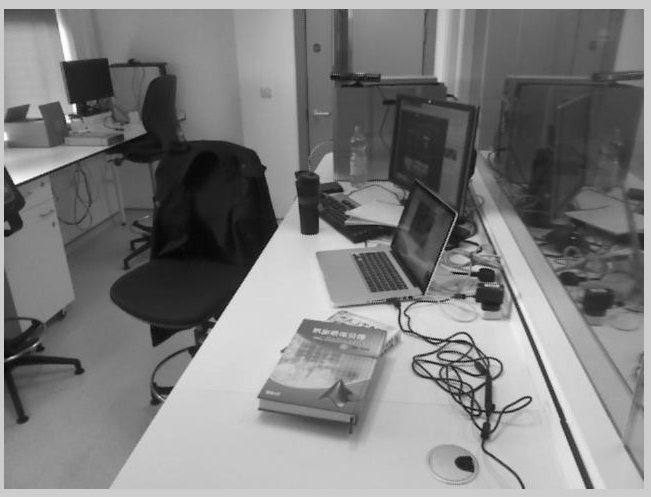
。'fliplr' and 'flipud' are 2 functions included in the Computer Vision Toolbox in MATLAB
。Result of doing 'fliplr: (the upper one is 'before fliplr'; the lower one is after 'fliplr')
camera frames
。The process should be progressed in these order: easier cases, normal cases, difficult cases
。Collecting these 4 databases: rotation, scaling, change perspective, affine
。Do matching by using SIFT first, then thinking more additional features which could be included
III. Studying the following literature to get more ideas about useful features in our work
。http://www.robots.ox.ac.uk/~vgg/research/affine/: (especially this work)
K. Mikolajczyk, T. Tuytelaars, C. Schmid, A. Zisserman, J. Matas, F. Schaffalitzky, T. Kadir and L.
Van Gool, A comparison of affine region detectors. In IJCV 65(1/2):43-72,
2005
。'feature matching' is description of functions included in the Computer Vision Toolbox in MATLAB
IV. May be trying to use my proposed method based on feature matching to test our collecting
dataset mentioned in 'II'
V. Considering to stitch several Kinect frames into one after checking current results of feature
mapping is acceptable
。Relevant method: http://www.cs.bath.ac.uk/brown/autostitch/autostitch.html
Friday, 4 April 2014
Work of Camera Calibration (5) : Construction of Panorama from Kinect frames - (B): Image Stiching
I. Image Stitching example 1:
。Automatic Panoramic Image Stitching using Invariant Features.
M. Brown and D. Lowe. International Journal of Computer Vision. 74(1),
pages 59-73, 2007
。Recognising Panoramas.
M. Brown and D. G. Lowe. International Conference on Computer Vision
(ICCV2003). pages 1218-1225, Nice, France, 2003
。AutoStich:
- https://www.cs.bath.ac.uk/brown/papers/ijcv2007.pdf
- http://cs.bath.ac.uk/brown/papers/iccv2003.pdf
II. Image Stitching example 2:
。http://phvu.net/2013/04/10/image-stitch-matlab/
III. Image Stitching example 3:
。Panoramic photograph stitching: using max-flow
- http://www.cb.uu.se/~cris/blog/index.php/archives/76 (ver 1)
- http://www.cb.uu.se/~cris/blog/index.php/archives/393 (ver 2)
。DIPImage Toolbox
- http://www.diplib.org/download
- file:///J:/References/10.%20Image%20stitching/DIPImage/dipimage_user_manual.pdf
IV. Image Stitching example 4:
Thursday, 3 April 2014
Work of Camera Calibration (5) : Construction of Panorama from Kinect frames - (A): Apps
I. Literature Review:
。Microsoft Research: Geometric
modeling from images
。Microsoft Research: Photosynth
。Noah Snavely, et al. (2008) Finding
path through the world’s photos.
ACM Transactions on Graphics, vol. 27, Issue 3, no. 15
ACM Transactions on Graphics, vol. 27, Issue 3, no. 15
Wednesday, 2 April 2014
Summary of Weekly Meeting - (5)
I. We discuss the matching results between hand-held camera frames and Kinect frames
generated by using SIFT.
。 More features may need to be included to improve the accuracy of matching 2 frames taken from
hand-held camera as well as Kinect.
II. Additional pre-processing step to improve the accuracy of the matching results is considered.
。Stitching several Kinect frames taken under different perspective in order to maintain a panorama view (2D plane-like outcome is the the first step; 3D sphere-like one is the second step)
。We are able to match a hand-held camera frame to this panorama view at the right location (which
means the field of view in part of the panorama view contains most of information similar to the
hand-held camera frame, including similar perspective and items within the image)
III. Keep find useful features and combine with the SIFT features to achieve higher accurate
matching between frames taken from hand-held camera as well as Kinect.
Tuesday, 1 April 2014
Work of Camera Calibration (4) : SIFT-Based Method
I. Camera Frames to Camera Frames
。Example 1:


。Example 2:

II. Camera Frames (Dataset 1) to Kinect Frames
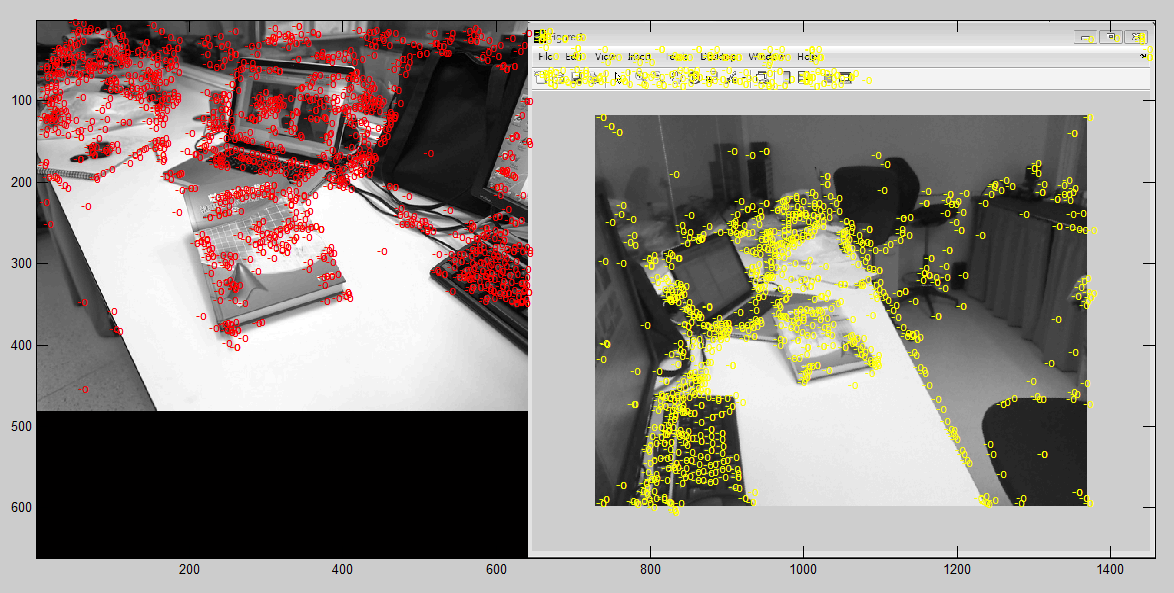
。Case 1:
- Finding keypoints on Camera Frame (left)... 1293 keypoints found.
- Finding keypoints on KinectFrame (right)... 1121 keypoints found.
- Found 14 matches, and 3 match is true.

。Case 2:
- Finding keypoints on Camera Frame (left)... 1177 keypoints found.
- Finding keypoints on KinectFrame (right)... 1121 keypoints found.
- Found 2 matches, and 0 matches is true.


。Case 3:
- Finding keypoints on Camera Frame (left)... 1170 keypoints found.
- Finding keypoints on KinectFrame (right)... 1121 keypoints found.
- Found 5 matches, and 0 match is true.


。Case 4:
- Finding keypoints on Camera Frame (left)... 1329 keypoints found.
- Finding keypoints on KinectFrame (right)... 1121 keypoints found.
- Found 0 match.


III. Camera Frames (Dataset 2) to Kinect Frames
。Case 1:
- Finding keypoints on Camera Frame (left)... 1124 keypoints found.
- Finding keypoints on KinectFrame (right)... 1223 keypoints found.
- Found 3 matches, and 1 match is true.


。Case 2:
- Finding keypoints on Camera Frame (left)... 1074 keypoints found.
- Finding keypoints on KinectFrame (right)... 1223 keypoints found.
- Found 5 matches, and 0 match is true.


。Case 3:
- Finding keypoints on Camera Frame (left)... 1426 keypoints found.
- Finding keypoints on KinectFrame (right)... 1223 keypoints found.
- Found 2 matches, and 0 match is true.


。Case 4:
- Finding keypoints on Camera Frame (left)... 1217 keypoints found.
- Finding keypoints on KinectFrame (right)... 1121 keypoints found.
- Found 2 matches, and 0 match is true.


IV. Camera Frames (Dataset 3) to Kinect Frames
。Case 1:
- Finding keypoints on Camera Frame (left)... 1286 keypoints found.
- Finding keypoints on KinectFrame (right)... 1611 keypoints found.
- Found 3 matches, and 2 matches are true.


。Case 2:
- Finding keypoints on Camera Frame (left)... 1058 keypoints found.
- Finding keypoints on KinectFrame (right)... 1611 keypoints found.
- Found 1 matches, and 1 match is true.

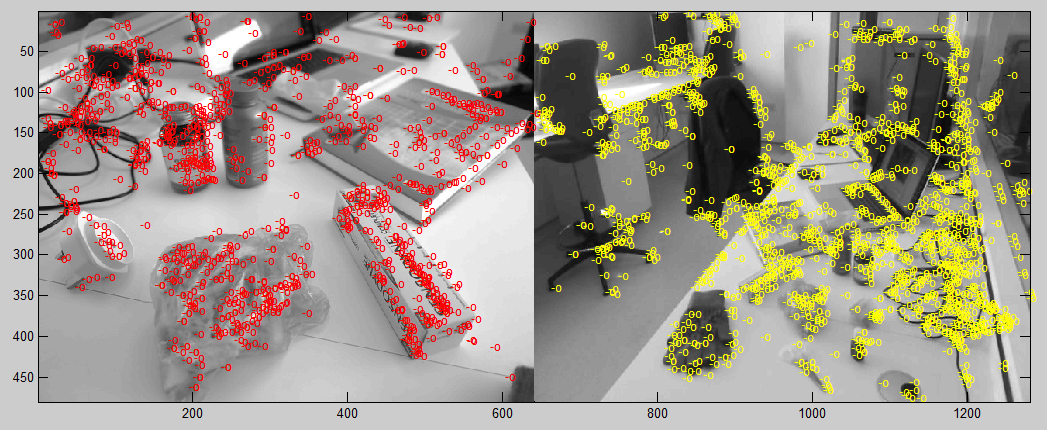
。Case 3:
- Finding keypoints on Camera Frame (left)... 933 keypoints found.
- Finding keypoints on KinectFrame (right)... 1611 keypoints found.
- Found 3 matches, and 0 match is true.


V. Notes of Problems During Programming
1. 'if isrgb(image)':
。Need to be modified to 'if (ndims(image)==3)'
。http://blog.csdn.net/meianan/article/details/8859792
。Example 1:
。Example 2:
II. Camera Frames (Dataset 1) to Kinect Frames
。Case 1:
- Finding keypoints on Camera Frame (left)... 1293 keypoints found.
- Finding keypoints on KinectFrame (right)... 1121 keypoints found.
- Found 14 matches, and 3 match is true.
。Case 2:
- Finding keypoints on Camera Frame (left)... 1177 keypoints found.
- Finding keypoints on KinectFrame (right)... 1121 keypoints found.
- Found 2 matches, and 0 matches is true.
。Case 3:
- Finding keypoints on Camera Frame (left)... 1170 keypoints found.
- Finding keypoints on KinectFrame (right)... 1121 keypoints found.
- Found 5 matches, and 0 match is true.
。Case 4:
- Finding keypoints on Camera Frame (left)... 1329 keypoints found.
- Finding keypoints on KinectFrame (right)... 1121 keypoints found.
- Found 0 match.
III. Camera Frames (Dataset 2) to Kinect Frames
。Case 1:
- Finding keypoints on Camera Frame (left)... 1124 keypoints found.
- Finding keypoints on KinectFrame (right)... 1223 keypoints found.
- Found 3 matches, and 1 match is true.
。Case 2:
- Finding keypoints on Camera Frame (left)... 1074 keypoints found.
- Finding keypoints on KinectFrame (right)... 1223 keypoints found.
- Found 5 matches, and 0 match is true.
。Case 3:
- Finding keypoints on Camera Frame (left)... 1426 keypoints found.
- Finding keypoints on KinectFrame (right)... 1223 keypoints found.
- Found 2 matches, and 0 match is true.
。Case 4:
- Finding keypoints on Camera Frame (left)... 1217 keypoints found.
- Finding keypoints on KinectFrame (right)... 1121 keypoints found.
- Found 2 matches, and 0 match is true.
IV. Camera Frames (Dataset 3) to Kinect Frames
。Case 1:
- Finding keypoints on Camera Frame (left)... 1286 keypoints found.
- Finding keypoints on KinectFrame (right)... 1611 keypoints found.
- Found 3 matches, and 2 matches are true.
。Case 2:
- Finding keypoints on Camera Frame (left)... 1058 keypoints found.
- Finding keypoints on KinectFrame (right)... 1611 keypoints found.
- Found 1 matches, and 1 match is true.
- Finding keypoints on Camera Frame (left)... 933 keypoints found.
- Finding keypoints on KinectFrame (right)... 1611 keypoints found.
- Found 3 matches, and 0 match is true.
V. Notes of Problems During Programming
1. 'if isrgb(image)':
。Need to be modified to 'if (ndims(image)==3)'
。http://blog.csdn.net/meianan/article/details/8859792
Subscribe to:
Posts (Atom)